We had a cultural event project where my discourse class was split into groups, and everyone attended a cultural event. In each group, we decided what kind of events we would attend and whether we would all attend the same event. My group decided to go to the UMKC Conservatory Orchestra’s Ensemble Series on February 9, 2017. We chose to attend this event because it was on campus, and as we’re all broke college students, it made sense to attend a free event. I, for one, love music, so I was excited to go to a free orchestra concert.
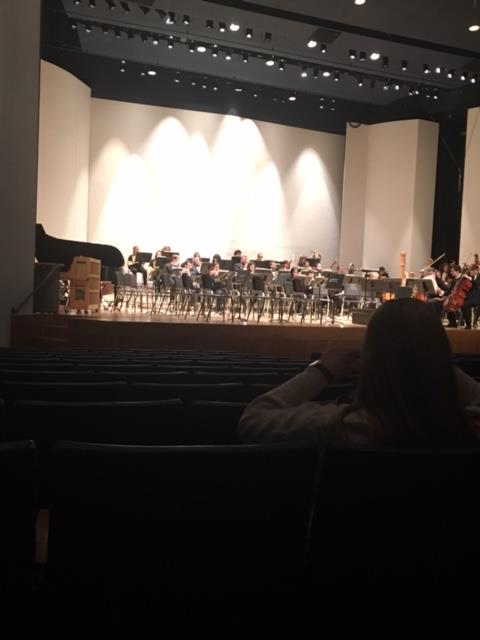
Going into the James C. Olson Performing Arts Center’s White Recital Hall, I was surprised at how small the room was. I had never actually been to an orchestra concert before, so I expected the room to be much larger. I love music, but I’ve never been a big fan of classical music, so I was expecting the performance to be a little boring. Most of the classical music I’ve listened to has been slow, and put me to sleep.
We arrived at the Performing Arts Center early and waited in the lobby for the roods to open. Everyone kept to themselves as the excitement for the performance grew. When the doors opened, we entered the warm and inviting atmosphere in the White Recital Hall. My group found a row large enough to sit together, and the lights dimmed so the performance could begin. The musicians on stage began by tuning their instruments, and then the concert master for the first half of the performance, Samuel Huang, entered joined the other musicians on stage. He was welcomed with applause, as was the conductor, Robert Olson, who entered after him. Mr. Olson introduced the flow of the evening, and the concert was kicked off by Sensemayá by Silvestre Revueltas. The seven-minute piece connected us to the ritualistic practices of the Maya civilization with its chaotic rhythms.
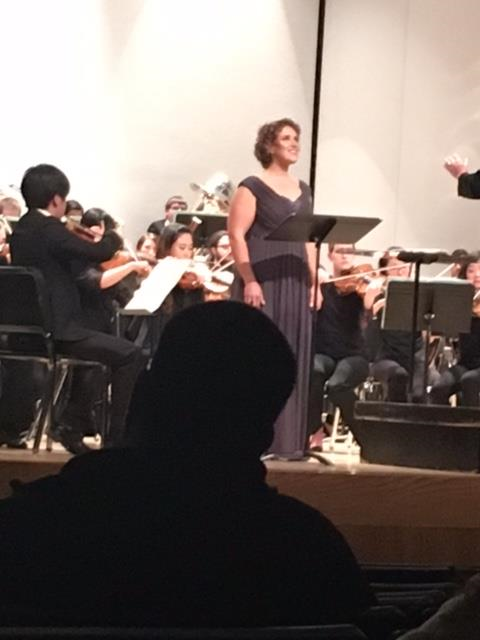
Next, a vocalist, Laurel Weir, joined the orchestra on stage for the four-piece ensemble, Vier Letzte Lieder by Richard Strauss. The piece was gorgeous and entrancing. I was captivated by the beauty of the music. It didn’t feel like I was sitting in a recital hall. I felt like a part of the music. After this roughly thirty-minute piece, there was a fifteen-minute intermission. During this break most of my group stayed together and talked about the first half of the performance. We didn’t really interact with anyone we didn’t know. The lights dimmed again, and the performers returned to the stage. The second concert master, Shupei Wang, entered along with Mr. Olson, and the final stage of the performance began. The last piece was Symphony No. 4 in E Minor by Johannes Brahms. The four-part ensemble began slowly and grew more dramatic with each piece. It was breathtaking.
This experience was different than I was expecting. The music was exciting, and I felt connected to it in a way I’ve never felt connected to music before. It wasn’t like simply enjoying a song on the radio. It was much more than that. I felt like I was transported the where and when the music was written. I was a part of the Mayan rituals in Sensemayá, I felt what Richard Strauss felt in Germany when he wrote Vier Letzte Lieder, and I was taken away by the emotion in Symphony No. 4. Overall, I had a fantastic time at this event. It showed me that we are all connected. We all feel things, and everyone’s feelings are valid, important, and not so different from my own feelings.
The orchestra that performed these pieces was the UMKC Conservatory Orchestra. It is led by Robert Olson and performs several times a year (info.umkc.edu). The vocalist, Laurel Weir, is an opera performer from Ohio who received a Master’s degree from the Cleveland Institute of Music. She made her opera debut in 2012 (Pamphlet).